
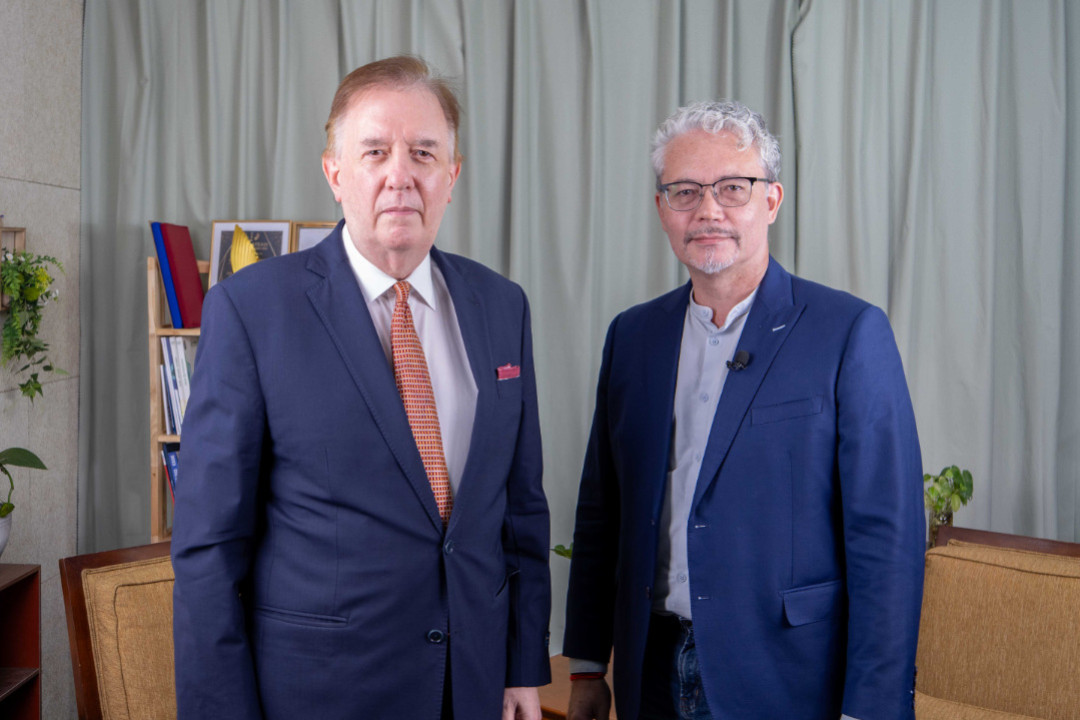
Anthony Galliano, Group CEO of Cambodian Investment Management (CIM), sat down with Samuel Doe, CEO & Founder of Imajineer, to discuss how Cambodia's real estate market is currently doing and what we can expect for the future.
Doe founded Imajineer in Cambodia in 2023 as an architectural visualisation studio built to give developers, architects, and designers a clearer way to communicate design intent and move projects forward. The company has since shifted from visualisation-first to development-led, with 'Citadel Manor' – one of Imajineer's three planned projects – set to begin construction in late 2026.
Anthony Galliano: “Can you give us a little background of your career and what brought you to Cambodia?”
Samuel Doe: "My career started out in Silicon Valley. I basically did software development, video game development, became a little micro-star in that industry. What I learned from that is architecture is everything. If you fail at designing something architecturally, it all trickles down to bad results. I retired at 33 and then got bored being retired. Then I transitioned to moving to China in 2010 and I developed a few businesses there in the yacht business, high-end wine distribution in Shanghai, throughout China. Then I got into real estate by chance.
“A few of my friends introduced me to Cambodia and I didn't really know much about the country, I don't think most people do. As far as from the American perspective, we have these perceptions, and I'm hoping to still keep educating people in the market to dispel those. So, I got into real estate in 2010 and we expanded throughout Asia with our agencies. Now I've transitioned from agency to developer because I see that the 2026 market is completely different than what it was before, which was speculative. Pretty much, you just stood in front of a building and you could sell it. But now, there are more sophisticated investors in the market.”
Anthony Galliano: "There was a little bit of a blip when we had the Asian financial crisis where real estate kind of stalled a bit and there was talk in the market that we were finally experiencing a cycle. But, at that time, the market was so small and contained that it wasn't really affecting the economy. It wasn't mature enough and a lot of the prime real estate was held in a few hands. It's now spread across the market, and the bank's are also lending on real estate, which was unheard of when I first came here.
“So there was really no lending on real estate, especially in the consumer market. Now we have mortgages, the banks are lending to individuals to buy houses and apartments. So where do you think we are? Is this Cambodia's first real estate cycle, and where do you think we are in the cycle?”
Samuel Doe: "We're in stage two, pretty much. We're in the sophistication stage, and this is actually great for investors, to jump in during this particular time, because we've transitioned away from generic construction and generic buildings. A lot of the developers early on were selling based off of just renderings and ideas. Now was ask, 'What is the property management? What is the actual nuts and bolts property location? What are the amenities? What are the things I'm going to get, and then how are you going to give me those rental returns? Is it guaranteed?'. All these aspects investors are now more interested in.
I think this is actually the best time to be investing compared to before, when it was all guesswork. Now we've seen the bad actors all play out. And people always tend to use this word, saying that we're ‘oversupplied’. We're not. We're under supplied in a market for investors. We're oversupplied for generic buildings.
Anthony Galliano: “I'll get to that point because I'm hearing the narrative in the market now is that there are more luxury brands, better buildings, things that offer more to the buyer. The narrative really is focusing on quality, and there is demand for quality. Is this where we're at today, that if you have quality properties, they'll sell?”
Samuel Doe: “Well, we're at two stages, really. We're at a stage where it's still slightly speculative. People are looking at buildings in the sense of the price point, what their risk tolerance is as an investor. But I'm targeting the classic investor that's looking for quality and all the fundamentals. Basically my rental returns, capital gains. And those are all based off of architectural design, like the elevators to units ratio, things like that. In my building, Citadel Manor, we are at one [elevator] to 40 units, which is considered ultra luxury in Manhattan. When you put that in perspective, some of these other buildings that we were talking about, the generic ones, they're at a minimum of 1 to 80, or 1 to 120 units. I've even seen as high as one elevator to 200 units in Sihanoukville. So, that's kind of where we're at in that mix.”
Anthony Galliano: “There is a lot of talk about over-development (oversupply). There are some developers that are up to a certain number of projects being sold with, maybe, still half of those not being built yet. How would you advise somebody coming to you and saying they want to buy a property but it's not developed yet? Should they just focus on properties that are already in play?”
Samuel Doe: “It comes down to, really, the fundamentals. There are certain projects and certain things that we evaluate with our clients. We do a lot of due diligence, that's the main focus of our small boutique firm. Most of the good developers, they deliver on time. There are, of course, certain factors that are out of their hands, like regarding supply chains. And the government here is trying to fix that with the new canal to bring goods from China easier to Cambodia, because most of our steel, our furniture items, all come from China. So, it's more of a supply chain issue on the delays. But I still believe in off plan, I really do. The early entry is the best way. Secondary market is a bit difficult. It's hard to say whether [the secondary market is fit] for an average investor, it's more for sophisticated investors to evaluate.”
Anthony Galliano: “Let's talk about what may be available in the provinces. When you talk about the property market in general, it's usually the major cities – Phnom Penh, Siem, Reap, Sihanoukville, sometimes Battambang gets in the mix. But I'm seeing now, foreigners who want more of a, let's say, relaxed life, or a retirement life, are really moving to more remote places that wouldn't be considered in the past. So, which provinces do you see developing? I know Kampot now has become sort of a haven for a lot of foreigners. There's Kep, but it's not quite there yet. Kep is extraordinarily beautiful and I wish we could see more developments.”
Samuel Doe: “Actually, I disagree with you because I like Kep the way it is! I don't want it to be damaged. We need one sanctuary for us. Phnom Penh has always been the anchor, is what I always tell our investors. All the other areas that are developing are more of a diversification play for us to diversify investments in those other provinces. If they want to land bank or something along those lines through a trust or some type of measure like that. We are looking at seeing Siem Reap for a bigger expansion. We have quite a few development projects under our real estate company. We're seeing a lot of development in Siem Reap and it's exciting.”
Anthony Galliano: “What does Siem Reap offer? Is it in terms of the economics of living there, the standard of living, the facilities? What is the attraction to see?”
Samuel Doe: “I would say the first attraction is the quality of life, the standard of living. Second would probably be that it's very zen, relaxed, if that's what you're going for. I'm more of a technologist and city person. I can escape there, but I cannot stay there. It's designed for someone that's more into a holistic lifestyle. That's what I think it has to offer. The quality of builds are increasing. It's not going to be a very tall city because there's a lot of restrictions, and I'm thankful that they're being respected. I think the government's doing the right thing on capping everything and making sure that it is going to grow more outwards, like London."
WATCH: Where Does Cambodia's Real Estate Market Currently Stand? - Interview With Samuel Doe - Pt. 2
Anthony Galliano: "Why don't you give us a little more background on your project, Citadel Manor?"
Samuel Doe: "Citadel Manor is in Tuol Tom Pong 2. We are building a sanctuary, basically, in the middle of the city. We have a Japanese zen garden. It's 37 storeys, but limited to only 160 units. We don't want an overcrowded building. We could have easily built 400 units in a 37 storey building, but we chose not to. We wanted to go after an extraordinary lifestyle. We have dry cleaning inside the building, we have laundry services, we have robotic cleaning of all the floors. Of course, we have standard cleaning staff. We also have, basically, a five star hotel lifestyle. And we have valet parking. Our ratio to parking to the building is higher than the standard as well.
“Like I was mentioning earlier, we have only one elevator to every 40 units. So you'll get to your unit within less than a minute and a half. It's very important to me to be different than the market, to bring a little bit of American standards to Cambodia, like what we would expect in Manhattan. That's what Citadel Manor is to represent.”
Anthony Galliano: “In our real estate updates, we realised that our audience wants to know where the market's going to go. So, it's fair to say, and if I could segment by residential and commercial, that prices are down 30 to 50 per cent on residential, and there's been a severe drop on rentals per square metre price for office buildings, which has been great for businesses. I've seen an incredible decrease in even the centre of the city. It's just amazing how rents have dropped.”
Samuel Doe: “I think it's still a matter of perspective. Before, it was a speculative market and prices were originally at around USD 24 to 25 a square metre for commercial buildings. Now I'm down to, I think, about USD 15 or 12.”
“I think I was overpaying to begin with. Then if you look at the residential side, as we already spoke about, there were a lot of generic offerings out there, and property management wasn't done correctly. So, we've seen buildings that were built only five to 10 years ago that now look 20 to 30 years old, and that shouldn't have happened.”
Anthony Galliano: “I think we may have a little difference of opinion, as I think it's oversupply. I think developers really overbuilt and there is a huge amount of inventory, which has really depressed the pricing, that's a large component of [this drop]. Again, you may disagree. Have you seen a deceleration of projects, or are developers still going ahead even with the supply problem?”
Samuel Doe: “We've seen from the high of 8,900 units coming to market in the earlier days, to now 3,900 or 3,800 per year. Like I said, I think the deceleration is really just from the bad actors in the market that were just building anywhere and without any thought, any layout and of poor quality. I'm not sure what we're going to do with those buildings in the market.”
Anthony Galliano: “I mean, we don't have the population.”
Samuel Doe: “Yeah, we don't have the populate, that is the problem here.”
Anthony Galliano: “If you looked at some of countries like Indonesia, Thailand and the Philippines, they have huge populations, And Vietnam is 100 million people. So, in those countries, the migration from the provinces to the cities has helped historically to pick up the housing. Here, we're still 75 per cent rural, but I think those people are priced out generally, because they're generally farmers or factory workers or whatever the case may be, and they're at a per capita income of USD 250 or USD 200, so they're not in a position, really, to pick up a couple hundred thousand dollar condominiums or property.”
Samuel Doe: “True, true. Maybe rental, but even then, the rental price will be still possibly too high as well.”
Anthony Galliano: “And finding a job. The jobs have to be created for people to come to the cities.”
Samuel Doe: “Well, I have a lot of hope in the direction the government's taking. We have our very first electronic tablet manufacturer here. So, we're heading towards technology more and it's only been four or five years. We've had the universities going in that direction as well. It's going to take a couple cycles to get there.”
Anthony Galliano: “I think the government's got it. I mean, I've been saying this forever. Garments, travel bags, bicycles, these are the low complexity, lower-end manufacturing, where you're really competing with a big part of the world, like in South America and Africa, Bangladesh. The government's understood this. I just attended [an event at an] automotive university. We now have four car manufacturers here.”
“DENSO's here, the Japanese will probably come in a much bigger way. So, we will get to middle-level manufacturing at least, and that will require more migration from the provinces to fill those jobs. The resilience of the Cambodian economy is quite amazing and the government is doing a great job in progressing to the next stages of where we're going to be.”
Samuel Doe: “I agree.”
Anthony Galliano: “Let's close on the market itself, because you have great experience with dealing with foreign investors, foreigners coming in that want to buy properties here, as well as domestic investors. Cambodia is addressing some of the reputational issues for foreigners that may want to invest. I think the government's doing a really good job of cleaning up some of the things that needed to be cleaned up. That hopefully will attract more foreigners, let's say, from the western part of the world. Vietnam, Thailand and Philippines have really benefited from the perspective of being a retirement place, or even a six month place, or just in buying property there. What would you pitch to a foreigner to come live and retire here in Cambodia? Why is Cambodia attractive to buy a property, in general, not even to be a retiree, but to buy a property versus in the other parts of Asia?”
Samuel Doe: “A lot of our clients now are from Europe and it's retiree focused. A lot of them are looking at their retirement, which is about five to six thousand Euros from their government job, maybe they were a police officer or fire person, and now they realise they cannot afford to even live in France at that price point. Then when we show them that with this retirement fund, you can live like a king here, that you can use Cambodia as a home base, and retirement visas are very easy to get for those 55 and older. Then they start to realise [the difference even] compared to Thailand, where now there are a lot of restrictions, even with bank accounts. And you have Vietnam, where it's very difficult to get money in and out, limitations on capital. Cambodia doesn't have any of those. We have all of the benefits from the visa standpoint, and no restrictions on money and currency. It's also a dollarised economy, so they don't need to worry about currency fluctuations that you would see in those other countries as well.”
Anthony Galliano: “I also want to address that Cambodia is probably one of the safest places in the world. The perception otherwise is completely unfounded. How do you address that when you're meeting foreign buyers that ask if it's safe to live in Cambodia?”
Samuel Doe: “I just think it's a bit naive. There's a lot of bad history, I think we get a bad rap for that here in Cambodia. It's kind of like, if you go down a dark alley in your own native homeland, it's going to be scary and you might worry. But here, I don't feel any concern about that.”
Anthony Galliano: “I will ask you just to end with a short pitch on why buy Cambodia.”
Samuel Doe: “I would say, please give us a chance. Just come here, take a week or a month. A month is a proper amount of time to truly understand the beauty of Cambodia. It has so much to offer, it really does. The quality of life you're going to have in your retirement, in your golden days, or even in your younger youth. Invest here in the early stage and then travel the world, come back and enjoy the beauty here.”