
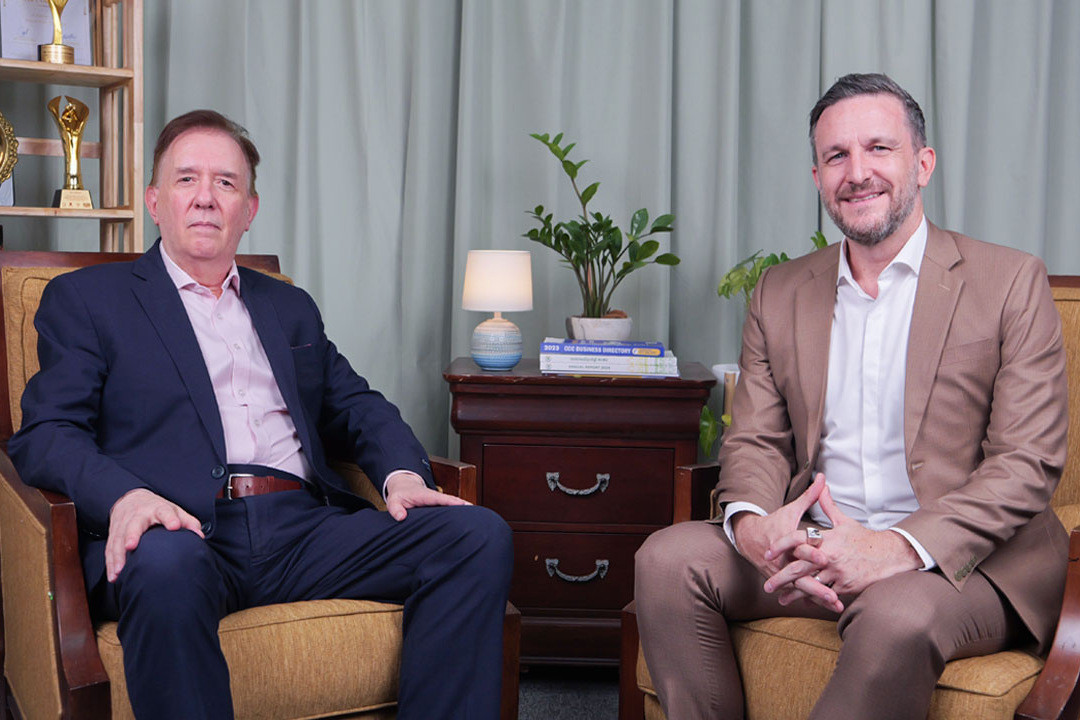
Anthony Galliano, Group CEO of Cambodian Investment Management (CIM) and Director of B2B Asia News, sat down with Jesse McCaul, Director at Invest Cambodia, to talk about Cambodia's investment landscape and to help dispel some of the negative myths and outdated perceptions that cause people to overlook the country's potential.
Anthony Galliano: “Jesse, thanks for coming to the B2B Asia News studio. We're two Americans that have been here a really long time and people would, I hope, be a little curious about what brought us here, why we've been here such a long time. And we really want to dispel negative myths about Cambodia. I've been an investor in Cambodia, you've been an investor in Cambodia. You brought investment in, I brought investment in. So, why invest in Cambodia? Why has there been a reluctancy to invest in Cambodia? And how could we encourage international investors to come to Cambodia and invest? Give us a little bit of background.”
Jesse McCaul: Thank you, Anthony, it's a privilege to be here. Much respect, of course, for everything that you have done for the nation, for the business community here. Originally a young man from the United States, the state of Oregon, I visited Cambodia in 1995. The story is that from ‘91 to ’93, you had the United Nations peacekeeping troops here. At that point, it was the largest peacekeeping operation by the United States.
In '93, there were elections, a new constitution, and the word on the street was that Cambodia was basically a new nation that had just opened up or reopened up. The word on the street was also that the government was inviting people to come and take part in rebuilding the nation. So, as a young American kid, even the concept of rebuilding a nation from kind of the ground up was a very foreign concept, but I reckoned it would be, to a degree, kind of a once in a lifetime opportunity to be on those ground stages.
"People ask me, weren't you worried about safety and things like that? And naively, or not, my simplistic thinking was the United Nations had been here, there are aid workers here, development workers here. And so if they were here, it must be somewhat safe and decent. So, I thought I would to try that for a year, do something meaningful for a year. I spent one year in Cambodia, which was a nice year, then went back to live my normal American life. Then long story short, caught the Cambodia bug and found myself here shortly after that.
"It's been an amazing journey over many years. Just like yourself, Anthony. I think, not just myself, but people like us are able to pretty adequately answer those questions of: Why Cambodia? Is Cambodia visitable, or even investable? Is there anything worth anybody's time in Cambodia? These are viable questions.
As anyone should understand, perspective is very important, and having the wrong perspective brings you in the wrong direction… There are a lot of wrong, or outdated, perspectives about Cambodia, which means many people are overlooking Cambodia. Overlooking means Cambodia could be looked at as a missed opportunity.
"This means for those that come — and this is an invitation to come for those that come — they can find some good opportunity. Now, a caveat to that; every country has a different way of doing things. Every country has a different system. Coming into a place like Cambodia, it's not going to be the same as Australia, it's not going to be the same as the United States, it's not going to be the same as South Korea or Japan.
Every country has a different way of doing things. You need to get a good local guide, or someone that's kind of local, like us even, to help show you the ins and outs. Because there's abundance of opportunity, but how to seize it, how to structure it, how to make it happen, is a whole other thing.
Anthony Galliano: “So we know that looking at retirement life, Thailand has benefited. From those that sought nice weather, a cheaper lifestyle, beaches, sunshine, great food, cosmopolitan cities, there's Bangkok, Phuket. Vietnam is now taking advantage of this also, Vietnam has beautiful coast – Da Nang, Da Lat, and Ho Chi Minh is an amazing city in Asia. Phnom Penh, which has just sprouted up over the last 10 years, I think we have a thousand high rise buildings in Phnom Penh. Luxury condominiums and so forth. And our medical facilities have improved a lot, which is important for retirement.
I think it's a missed opportunity for a lot of retirees deciding to come to Southeast Asia and looking at Vietnam, Malaysia, Thailand, and probably not taking Cambodia too seriously. I come from New York, which isn't the safest place in the world, and I have been here in Cambodia 18 years and I have never ever had a problem.
"Maybe it's my height, I don't know comparatively, but I have never had a problem. It's probably one of the safest places I've ever lived and one of the easiest places to get around. It's probably not the cheapest place in Southeast Asia. It used to be, but it's getting more in line with, I think, what Thailand is, if not more expensive. So, that's a little bit of an unfortunate negative. But it's not expensive comparative to Europe or major U.S. cities. It's still a relatively cheap place to live with the ability to get great housing. We have our beaches as well. We have beautiful beaches on our coast. A new airport, easy to get around. Thailand's a 45 minute flight away, Vietnam's a 35 minute flight away.”
Jesse McCaul: “Singapore is two hours away.”
Anthony Galliano: “So, probably with medical facilities improving greatly, this is probably one of the better places to live in Southeast Asia, comparative to our neighbours. A little commentary on that?”
Jesse McCaul: “Absolutely. There's a lot of old news and old perspectives about Cambodia, so let's just lay it out there. In Cambodia you can live whatever type of lifestyle you want. The English colloquialism, American English colloquialism is ”roughing it" – you don't have to rough it in Cambodia. You can, of course, if you want, go and live in the sticks, in the jungle or whatever, but you don't have to."
Some people would think, like, ‘Wow, Jesse and Anthony are really roughing it by living in Cambodia, my heart goes out to them, I wonder if they eat well'. Like, what are you talking about? This is a very old and wrong perspective.
Anthony Galliano: “I'll put it in a very easy perspective. In my building, which is a five star building, there's an apartment next to mine which is being rented for USD 500, which is 74 square metres. We have a full Olympic sized swimming pool, we have a grade A gym, we even have a mini mart in the building. It's centrally located with a great management as well for the building. For 500 dollars a month!"
Jesse McCaul: “And we're eating okay, I think! I had a nice Japanese lunch here at a very nice Japanese restaurant. Last night, I had some nice steaks. There's a whole variety available, whether you want Middle Eastern, Greek, Korean, pizza.”
Anthony Galliano: “I think the safety thing is really a negative myth to break down. It's very safe here. It might seem weird for people because, actually, we don't have police on the streets, like in the U.S. or in European cities. At night there are no police on the streets."
Jesse McCaul: "And there's a thriving nightlife that people enjoy. But there is an elephant in the room to address, and that's some of the recent global news regarding scam centres and things like that that have affected Cambodia.
People are going to say, 'Well, if it's safe, then what about all these scam centres?'. First of all, let's put it in perspective. This is the golden age for scamming globally. In the history of the world, there's never been more scamming globally. There's a lot of places, whether it's Calcutta, India or whether it's Ponzi schemes running through the U.S. or the UK. There's a lot of bad stuff happening in that industry. Cambodia has fallen victim to some of this as well.
“And that would be isolated buildings run by non-Cambodians. These are, sorry to say, mafia type people from mainland China, and they are recruiting people online. Many of the people that are being recruited are young people. They don't care if it's black industry, white industry, grey, it's fast cash, I'll come and do it. Some of them are taking out loans from loan sharks, and then are being treated badly by loan sharks. You shouldn't take out loan from loan sharks. That's a life lesson. It's not a good industry, and it's being heavily cracked down on.
"Were there possibly officials that were turning a blind eye to it locally? Yeah, sure. But it is being cracked down on, and it's not a safety concern for even one Cambodian citizen, or any of the expat community as well. These are isolated buildings that you and I, or even an average Cambodian, wouldn't be allowed to get into even if they wanted to get into it. It's a terrible industry. It's despicable. Being cleaned up. Too much of it globally, but it poses no safety risk to any person living or even visiting the country.”
Anthony Galliano: "Yeah, it's very true. It's been an unfortunate stigma for Cambodia – not only Cambodia, but Laos, Myanmar, even Thailand has been affected – and, frankly, these didn't exist just yesterday, they've existed for quite a long time. It hasn't touched us as expats. That's not to say it's good, it's terrible what's happened with these scam centres, but it hasn't really touched us. We're aware of them, but we weren't really touched by them.
“The good news is this government has really cracked down. A monumental shift of how policy has now taken force in closing them down and repatriating the workers as well. It's one of our thorns in our side that's been addressed. Still a ways to go, it's not completely finished, but I think it's very positive.”
Jesse McCaul: “Yes, that's right.”
Anthony Galliano: “Now, the other negative perception is there's a war going on here, which is a border conflict that's been under ceasefire for some time. The U.S. thankfully got involved and assisted. Another thing that hasn't touched us because it really was just border clashes, which are not uncommon around the world with a lot of countries. But the perception is, unfortunately, that it's been touching the cities as well.”
Jesse McCaul: "We have families here, and we're not the only ones. We're just a couple of many. And there has never been one moment where anybody has ever had any fear for their loved ones or anything like that. It's unfortunate that there's border conflict happening, of course. It's calm and peaceful now, and there's some technical issues that will have to be resolved between the two countries.
Beyond the ‘safety’ aspect, and there is healthcare, good healthcare available here. In addition to that, what you will find in Cambodia is some of the most warm, authentic people you can find on the planet. And everybody can choose their own lifestyle.
"Some people may want to say, 'Well, I want to go to Cambodia and I just want to live in my little place. I don't want anyone to bother me and I don't really want to connect with anybody'. That's okay. That's the lifestyle that you choose, that's not a problem. If you are one of those that say, ‘Look, I want to live my lifestyle, I want my proper accommodation’, and if you're a family, maybe even want schooling for your kids, or if you're a retiree, maybe you just want to enjoy the beaches and some travelling, or good food that you're accustomed to – that's all available.
“But If you want to connect a bit, relate a bit to the local population, first of all, you'll find that so many people are English-speaking, and can speak other foreign languages too. What you won't find is plastic people that say, 'Oh, that's the non-Cambodian community and we don't have anything to do with them because we're the local community'. That will not happen. They will integrate you, invite you as much as you would like into their lives and into their community with very warm and authentic hearts and intentions, which in this day and age, around the globe, at times and in certain places, can be very hard to find.”
Watch Part 2 of Anthony Galliano's interview with Jesse McCaul:
Anthony Galliano: “The digitalisation of the government has been a big plus. The government's doing all that they can to make it a better place to do business. One of the things that we must touch upon is infrastructure, there's been a dramatic improvement in infrastructure. You've been here for, like you said, 31 years. We both have businesses here. What are the attractions of doing business in Cambodia?”
Jesse McCaul: “Let's talk about Cambodia in 2026. You have a very business and investment friendly administration and government. Just look at the policies, the books and, the various incentives that are offered for different types of investment here. It's a very pro-investment government for sure. In addition to that, 100 per cent foreign ownership of local businesses is an option here. You can choose a local partner if you want, but if you as a non-Cambodian comes in and wants to start a business, it can be 100 per cent foreign-owned. It's basically a dual currency economy here, using the U.S. Dollar as well, which is very attractive for some people.”
Anthony Galliano: “Although the government doesn't like to hear this, it's a dollarised economy. We're still 85 per cent, more or less, dollarised. I see that as a big plus because you're not having to deal with currency fluctuations, and you're dealing in the major currency for trade and commodities. Although, again, Cambodia is trying to be more sovereign-oriented, with more national pride attached to the Khmer Riel, which will come over time. But today, it's a plus, and we should use it as a plus."
Jesse McCaul: “That's absolutely right. You have a young workforce who are eager and digitally connected, speaking English and other foreign languages. Sixty five per cent of the population is under 30. You also have political stability here, and that's really important because what it means is you're not going to have any sudden knee-jerk changes because one party's just left office, and then the next party comes in and they change everything around. We don't have that here. You can predict pretty well where things are going politically, and that brings very good stability as well. There's always minor adjustments and things like that, but you have stable politics here.”
Anthony Galliano: "Another thing to touch upon is also the tax rate. It's 20 per cent for corporate tax, which is a little bit below the average, which is 23 per cent or so in ASEAN. There's been a dramatic change in the efficiency of the government, which has now become much more digitalised.
The ease of doing business – filing taxes, doing your accounting statements are all electronic – is just as much as it is in Singapore. You wouldn't have thought that Cambodia was that advanced. In other countries I do business in, it's not that advanced. So, the digitalisation of the government has been a big plus. As you said, the government's doing all that they can to make it a better place to do business.
“One of the things that we must touch upon is the dramatic improvement in infrastructure. The ports, the highways, the waterways, the Funan Techo Canal that's coming along, the two new airports; beautiful new airports in Phnom Penh and Siem Reap. Maybe you could touch a little bit more about the infrastructure development?”
Jesse McCaul: "One statement that I'll make, not just about infrastructure, but about the expectancy and the optimism for continued growth, development and progress in Cambodia. Sometimes you can predict the future by looking at some of the past as well. When I came here 31 years ago, which is a long time, but at the same time for the development of a nation, it's not that long. When I came here, there were maybe four paved roads in the whole capital city. The first house that I lived in, we bought a refrigerator and had to buy ice to stick in the refrigerator every day to keep it cold, because the power was out so much. Going up to Siem Reap was like eight or nine hours on terrible roads. The infrastructure was virtually non-existent just 30 plus years ago.
Now, we have connectivity all across the country. We have our beautiful new airport here. The Funan Techo Canal will be a game changer connecting all of Cambodia's waterways from the Mekong to the Tonle Sap, all of that directly to the sea, which will be a game changer once finalised. And we were talking earlier, before we came on air, about all the high rises and everything, not just in Phnom Penh, but around the country. Infrastructure is improving by the week, by the month. And if you look back not that long ago, it was basically about zero. To know that we've developed this quickly will help you predict what Cambodia will look like in the next five or 10 years. We're growing very quickly.
Anthony Galliano: “The question from our audience watching this would be, ‘You guys have been chatting a lot about how great Cambodia is, so tell me, if I came to Cambodia, what opportunities do you think I should look at?’”
Jesse McCaul: "It obviously depends on various appetites, various industries. There's still plenty of room in the logistics sector. There's been a lot of push lately, but there's plenty of room for numerous different international players to jump into that sector. Agriculture and agroprocessing is a wide open industry still. We have so much undeveloped agricultural land. We just had a guest from the States, and they're the largest grower and processor of Pekin duck in the United States. They were looking at Cambodia as a hub for export to the region.
“We haven't yet mentioned all of the various free trade agreements (FTAs) that Cambodia has with ASEAN, Europe, China. All of those positive attributes that we mentioned about Cambodia, they don't have to just be for the local market. You can utilise the tax incentives, the infrastructure, the workforce here for export market, and that could cover many industries.”
Anthony Galliano: “We have a Ford assembly plant, we have a BYD car plant, as well. And also electronics, we have to do electronics. We're starting to climb those rungs on the ladder a little bit. We're not doing semiconductors or anything that sophisticated, but that's the plan, I hope.”
Jesse McCaul: “With regards to infrastructure projects too, Cambodia has what they call a PPP framework, a public-private partnership framework. There are hundreds of infrastructure projects where the plans are there on paper, but the government invites the private sector to partner with the government on these. That's something that, of course, international groups can explore as well. Those could be from ports, to parks, to roadways, to railways.”
Anthony Galliano: “Once we really get over these issues with scam centres and now with the border conflict, hospitality was a huge pillar here before, and I think that will return, so there's a great opportunity in hospitality. Real estate was one of the best performing sectors, until [these issues came to light]. Real estate is cyclical and we had to learn that. Everything in real estate in Cambodia was going one way for a long time, and now we finally have a real estate cycle, and it's bottoming. We expect the next year or two to start seeing some uptick. We have a lot of land and a small population."
Jesse McCaul: "If you're young, or maybe even a younger middle-aged person, and you have time to wait and sit on an investment, real estate is still a very good investment in Cambodia. Right now it's a buyer's market. Sit on it for a little while and you'll do good."
Anthony Galliano: “Manufacturing is always an opportunity here. So, as we go from low-skill to mid-skill, we'll start seeing companies that will need mid-skill workers. We have very skilful people, very well-educated people and English-speaking people. So, there's a lot of opportunity here.”