
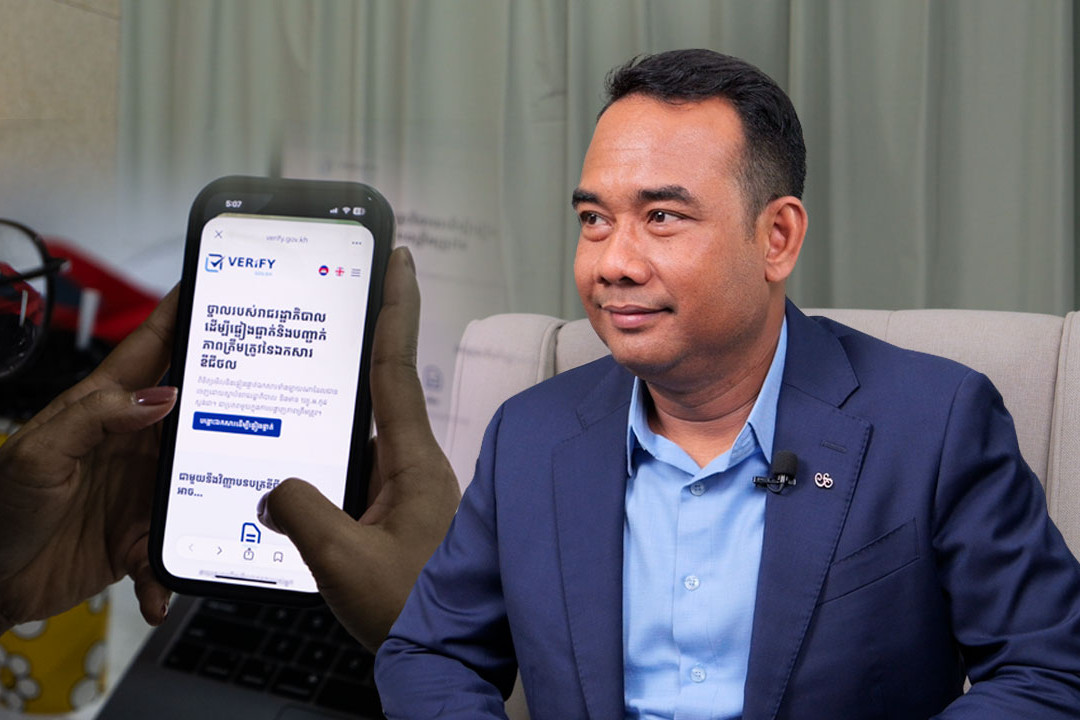
Cambodia is steadily positioning itself as an innovator in the regional and global civic tech landscape. At the forefront of this shift is verify.gov.kh, a locally developed digital platform designed to eliminate reliance on physical paperwork and streamline public service delivery.
In an exclusive interview with B2B Asia News, H.E. Chea Sereyvath, Secretary-General of the General Secretariat of the Digital Government Committee (DGC), detailed the platform’s security architecture, its rapid international expansion, and Cambodia's broader ambitions for digital public infrastructure (DPI).
Establishing the World’s Fourth DPI
The concept behind verify.gov.kh originated in 2019 under the vision of H.E. Chea Vandeth, Minister of Post and Telecommunications. As H.E. Chea Sereyvath recalled:
I met him in 2019, and he expressed his goal to create a paperless, digital government. After conducting research, we found that to achieve digital transformation on a national scale, there must be three key components of Digital Public Infrastructure (DPI), namely Digital Identity, Data Exchange, and Digital Payments.
However, the Ministry of Post and Telecommunications (MPTC) identified a persistent global gap: many nations possessing these components still relied heavily on physical documents.
"That led us to believe that something might be missing," he explained. “After further research, we realised that verify.gov.kh could serve as a platform that enables all public services to be requested, received, and used digitally.”
Following a one-year feasibility study and two years of development by an all-Cambodian team with international experience, verify.gov.kh was launched using blockchain, artificial intelligence (AI), and hybrid cloud infrastructure. The platform was envisioned to enable seamless cross-border document verification.
Our original vision was for it to become the fourth Digital Public Infrastructure in the world and to enable cross-border document verification, and eventually, we achieved that. Last year, in Egypt, the World Bank, UNDP, and other partners recognised this platform as the fourth DPI globally, acknowledging its potential to be applied in other countries as well.
Security, Integrity, and Architecture
Addressing security concerns inherent to digital transitions, H.E. Chea Sereyvath distinguished verify.gov.kh from older, second-generation verification models. Traditional digital setups often rely on a single central database governed by a master key – a vulnerability if the developer or infrastructure is compromised.
verify.gov.kh mitigates this risk by eliminating the master key altogether:
For verify.gov.kh, we don’t have that ‘master key’. This means that even if one day there were an intelligence intrusion — for example, if someone put a gun to the heads of everyone in the Digital Government Committee, demanding access to the data — they still couldn’t get it. Because even I, my developers, or those who manage the infrastructure, cannot see the data.
He added that to ensure absolute integrity, the platform utilises a strict co-sign architecture.
“Every document that is uploaded to the system must first be recognised and approved by the head of the issuing institution," said H.E. Chea Sereyvath. "After that, the institution sends the document to the DGC, which then signs it a second time — this is what we call a co-sign architecture. Only after both approvals can the document be uploaded to verify.gov.kh. If the institution’s chief does not approve it, the document cannot be verified.”
Presently, the platform verifies key academic and state documents, including the national BacII certificates (high school diplomas), civil service records, National Social Security Fund (NSSF) data, Police Clearance Certificates, and roughly 80 per cent of private university certificates issued in Cambodia.
Enterprise Integration and Scalability
For private sector enterprises looking to integrate verification protocols into their operations, the onboarding process has been heavily optimised.
"For private companies that wish to use verify, they can simply contact the MPTC, the Digital Government Committee, or visit verify’s official website," H.E. Chea Sereyvath stated.
The platform requires no pre-existing data management systems from corporate partners. "Even if they don’t have one, they can still use the verify platform. We can also build one for them," he added, noting that the integration timeline can be completed within “one to two weeks".
Furthermore, the architecture is designed for massive transaction volumes, capable of verifying "over four million documents in just one minute". Regarding potential mass use, H.E. Chea Sereyvath emphasised:
In Cambodia alone, we have already uploaded three million documents into the system. In the Philippines, they have reported more than 100 million documents in the system. So even if this platform were used in 10 or 20 countries worldwide, it would still perform efficiently without issues. Therefore, for Cambodia — with a population of around 17 million people — scalability is not something we need to worry about.
International Expansion and U.S. Academic Recognition
Following accolades such as the ASEAN Digital Award and achieving second place in a global competition organised by the International Telecommunication Union (ITU), Cambodia has actively exported the platform. The system was recently officially launched in Timor-Leste and is being implemented in Laos and the Philippines, with discussions also underway with Bangladesh.
The platform has also drawn interest from elite academic institutions in the United States. H.E. Chea Sereyvath shared that Harvard University intends to develop a case study on verify.gov.kh to share with other governments around the world. He added that discussions with another major American university have also yielded significant milestones.
“They agreed on two key points: first, all graduate certificates from Cambodia with the verify.gov.kh stamp, when submitted to them, will be recognised, which is a big success for us in the U.S.," he shared. "Secondly, they are also considering using verify for their own certificates in the U.S. For this second part, it’s already 99 per cent complete, but it still needs confirmation from their leadership.”
Expanding Cambodia’s Digital Public Goods Portfolio
verify.gov.kh represents just one component of Cambodia's broader push toward digital governance. The MPTC has developed more than 10 parallel platforms designed to serve as Digital Public Goods. These include GO.gov.kh, a platform to store public documents that each ministry can use, and nomsa.gov.kh, a product that can be used as a messaging app for communication between the government and the public. Another tool is sarika.gov.kh, which can create news content using real human speech.
Historically, fragmented adoption across different ministries has challenged civic tech implementation. However, verify.gov.kh has successfully overcome this hurdle. As H.E. Chea Sereyvath concluded:
Historically, when a system was developed by one ministry, other ministries would not use it, and that’s one of the challenges we’ve been trying to solve. But we have been successful with verify.gov.kh because verify has shown them that this is a unified platform — a platform that, after we develop it and they start using it, they won’t lose their authority. Now, all ministries are using verify.gov.kh, and other digital government platforms are also on the way.
With inbound institutional requests coming in on a daily basis, the MPTC is preparing its media team to launch a comprehensive promotional campaign to drive the adoption of its wider suite of digital products across the public sector.