
EuroCham & UNICEF Host Breakfast Briefing on Cambodia–Thailand Border Crisis, Spotlighting Business Impacts and Humanitarian Response
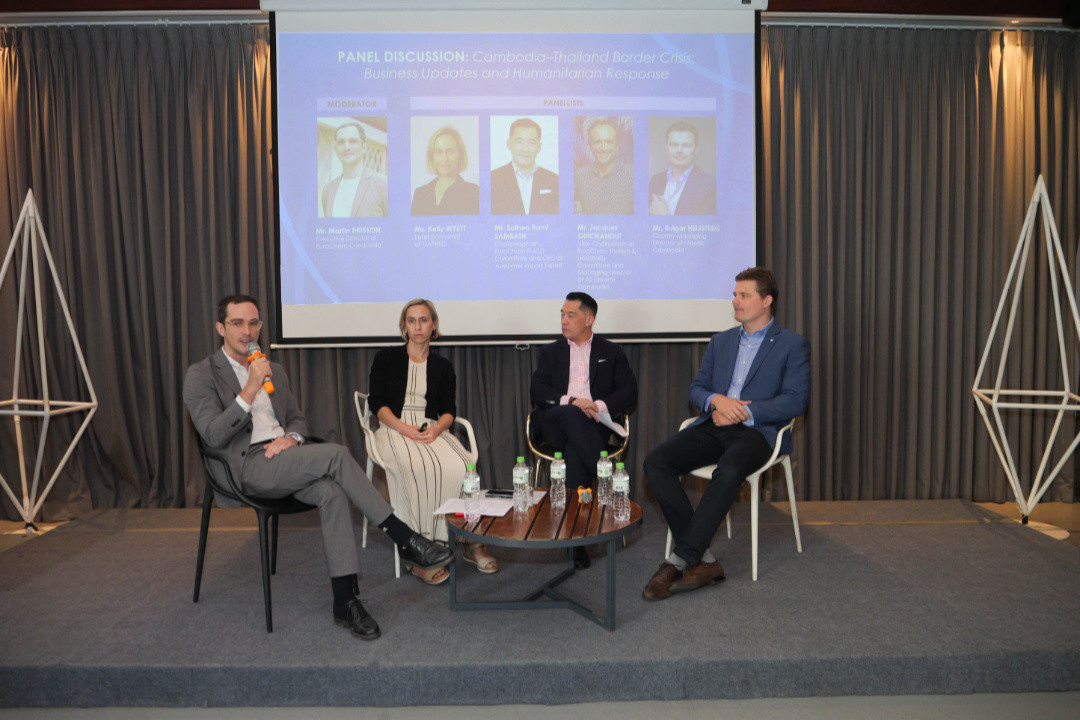
EuroCham Cambodia convened business leaders, economists, logistics experts, and humanitarian partners for a “Cambodia–Thailand Border Crisis: Business Updates and Humanitarian Response” Breakfast Talk on February 10, 2026, at Raintree in Phnom Penh. The session provided a timely platform for private sector dialogue on the economic, operational, and social implications of ongoing border tensions, alongside an update on humanitarian needs and response efforts.
Opening remarks were delivered by Dr. Will Parks, UNICEF Representative in Cambodia, and Gabriele Faja, Chairperson of EuroCham Cambodia. Both speakers underscored the importance of private sector engagement during periods of regional uncertainty, highlighting how economic disruption, displacement, and social vulnerability are increasingly interconnected. They stressed that safeguarding long-term development, particularly for children and families affected by the crisis, requires coordinated action across government, business, and humanitarian actors.
“We firmly believe that the challenges faced by children and youth cannot be addressed without the active engagement of the private sector," said Dr. Parks. "EuroCham members have a vital role to play—whether through partnerships with UNICEF, financial or technical support, or by integrating children’s rights into corporate policies and practices. Every child deserves access to essential services, from safe WASH and quality healthcare, to inclusive learning environments, and to grow up protected and healthy. We are grateful to EuroCham Cambodia for the opportunity to explore how companies can contribute responsibly to both development and humanitarian efforts.”
WATCH: Private Sector Support Crucial in Delivering Life-Saving Supplies - Dr. Will Parks, UNICEF Cambodia
The business panel discussion, moderated by Martin Brisson, Executive Director of EuroCham Cambodia, brought together sector experts to assess real-time impacts on Cambodia’s economy. Panellists—Kelly Wyett, Lead Economist of CAPRED; Sothea Rami Sambath, Chairperson of EuroCham FMCG Committee and CEO of Auskhmer Import Export; Rutger Heijsteeg, Country Managing Director of Maersk Cambodia—examined how border disruptions have affected tourism and hospitality, labour and workforce dynamics, transport and logistics operations, and FMCG markets.
Speakers highlighted declining tourism activity, supply chain rerouting, increased logistics costs, labour shortages driven by returning migrant workers, and shifting consumer behaviour, including a growing preference for locally produced goods amid boycotts of Thai-affiliated products.
Discussions also pointed to broader structural challenges, including pressure on the financial sector, rising operational uncertainty, and the need for more diversified sourcing and trade routes. At the same time, panellists noted that the disruption has accelerated conversations around domestic production, agro-processing, and longer-term economic resilience.
_20260212_113925.jpg)
“The current border situation highlights the importance for Cambodia to diversify its sourcing and strengthen self-sufficiency. This includes exploring alternatives from countries such as Vietnam, Malaysia, and Indonesia, and investing in domestic capabilities for products that currently rely heavily on the Thai market,” said Brisson.
He added:
In sectors like vehicle electronics and agri-processing, Cambodia has the opportunity to develop local production and add value domestically. For example, much of the country’s raw agricultural output is still sent abroad for processing. By building capacity locally, Cambodia can increase value addition and create export opportunities, including to the EU, without depending on external processing.
“From my experience in transport, logistics, and trade, successful trade does not always depend on having close or friendly relations between countries, it can thrive simply when there are shared needs. With that being said, Cambodia has made significant progress in terms of improving efficiency in logistics, particularly around customs procedures and documentation. But there are still opportunities to do more,” said Heijsteeg.
“Currently, administrative costs and built-in buffers for unexpected delays increase the overall cost of trade. By addressing these inefficiencies, the country can reduce unnecessary costs and strengthen its trade competitiveness, while ongoing infrastructure improvements continue to support growth,” he added.
_20260212_114141.jpg)
The second half of the program focused on the humanitarian dimensions of the border crisis, with UNICEF outlining the situation on the ground and its ongoing response. Presentations highlighted displacement in border provinces, impacts on access to education, healthcare, water and sanitation, and the heightened vulnerability of children, including those with disabilities.
UNICEF shared how it is working with government partners to deliver emergency assistance, restore essential services, and support recovery, while also calling on the private sector to play a role through responsible business practices, partnerships, and targeted support.
The session concluded with networking among participants, reinforcing the importance of continued dialogue between the private sector and humanitarian partners.
EuroCham Cambodia reaffirmed its intention to continue facilitating informed, solution- oriented discussions that help businesses navigate uncertainty while contributing to Cambodia’s broader social and economic resilience.
Donations to affected communities are still being accepted. Follow this link to learn how you can contribute: https://help.unicef.org/cambodia-appeal.