
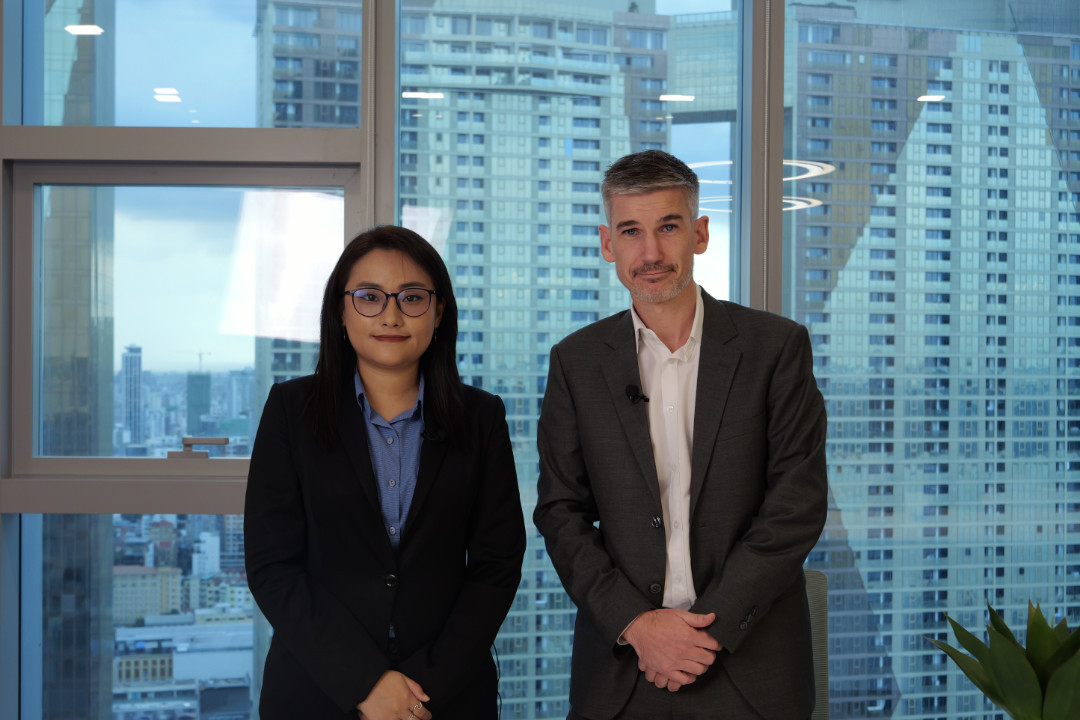
B2B Asia News sat down with Richard Nuttall, Director of Tax & Corporate Services at KPMG Cambodia, to discuss the situation in Cambodia concerning tariffs and supply chains.
B2B Asia News: Can you give us a breakdown on just how much supply chains have been affected in Cambodia due to fluctuating U.S. tariffs and the border crisis with Thailand? What has the cost impact been for businesses and consumers?
Richard Nuttall: "It's been a very eventful time so far. As you are aware, when the border crisis hit, quite quickly, the land borders were closed between Cambodia and Thailand. And that meant that a border that has traditionally seen a huge amount of trade and goods passed on a daily basis was closed overnight. This had a big impact for a lot of industries that were importing goods from Thailand. We have quite a few automotive manufacturers that rely on supply chains with their components coming from Thailand. We've got a lot of garment manufacturers, as well, that are sourcing their raw materials from Thailand. And then of course, we have consumer goods, retailers that have traditionally been importing a lot of goods for sale in domestic market, all also using the Thai border. So pretty much overnight supply chains had to be rearranged.
“I think the logistics companies did a pretty good job of quickly rerouting goods via Vietnam, Laos, sourcing product from different countries. But the overall impact has been an increase in costs, because, obviously, if you can move, if you're sourcing goods with a short distance between Thailand and Cambodia, and suddenly you have to go all the way up to Laos or around to Vietnam to bring the goods in, you've got additional costs in terms of transportation. You've got new processes for the clearance that perhaps the logistics companies aren't used to. So, a lot more cost involved, and that ultimately increases the cost for the consumers and for the factories that are processing those materials.”
B2B Asia News: Can you elaborate a bit more on what Cambodia done to try and lessen these impacts and ensure goods are still flowing in and that product demands are still met?
Richard Nuttall: “I think it comes down to the resilience of the supply chains. The fact is, [Cambodia] has been able to source products from different locations really quickly. Some of that maybe was built up during COVID, because we had a similar situation where borders were closed and products didn't flow. I guess during that time there were some skills and experience developed that could quickly be drawn on during this current crisis. Also, where you've got existing agreements in place, it may be difficult to renegotiate on the costs immediately. So, in the short term you might not see a significant increase, but over time you might start to see costs increase.”
B2B Asia News: While disruptive, do you think there has been a silver lining to the situation? Particularly in the way Cambodia has been able to identify dependencies and work on strengthening and diversifying its supply chains and domestic production capacity?
Richard Nuttall: "There are two things that came out of the crises that were kind of highlighted. The first one concerns the U.S. tariff crisis. I think in 2024, about 40 per cent of all Cambodian exports were to the U.S., so of course, if that market becomes disrupted, it's a huge impact for Cambodia as a whole. That indicates that, perhaps, Cambodia would be well-served by diversifying its export markets, because then it can insulate itself from shocks of this kind. But at the same time, the U.S. is the biggest consumer market in the world, so you don't want to ignore the biggest market you have. You need to manage the risks around that.
“In terms of the border crisis, that has shone a different light, like you mentioned, on how reliant Cambodia is on markets around the region for import. I think there's definitely scope for a lot of the goods that are being imported and sold domestically to be produced in country. That certainly is something that I think Cambodia can look at, to build out domestic industries. But that is not an easy fix, and there's a lot of barriers to do that. Certainly, going forward, I would love to see Cambodia be able to manufacture and make a lot of its own goods, because that's only going to help Cambodia develop as a country.”
Watch Part 2 of our interview with Richard Nuttall:
B2B Asia News: Cambodia received a fairly favourable 19 per cent tariff rate. In the long-run, what do you think the overall impact of U.S. tariffs will be on the Cambodian economy? Is there now a more equal playing field?
Richard Nuttall: "Going back to April, when the tariffs were first announced, we had Cambodia receive a tariff of 49 per cent, which I think was the highest, or at least, one of the highest in the world. There was a huge shock in the market here, and the feeling among many businesses was that we were going to become completely uncompetitive overnight, and investment was just going to flow out of the country.
"I think now that things have kind of settled at 19 per cent, and you've got other regional peers with similar rates of 19-20 per cent, there's, overall, a feeling of relief. And I do think it levels the playing field a lot. One thing we need to be conscious of, still, is the clause around transshipment, which has a 40 per cent penalty. So we know that a lot of manufacturers here are using products imported from China, or from other other countries, and then manufacturing in country and shipping to the U.S.
It's very important that companies are looking at their production process, understanding where their materials are sourced from, understanding what their processes are, and making sure that they meet the criteria to be a Cambodian origin product.
B2B Asia News: Cambodia also dropped its tariffs on U.S. goods to 0 per cent, with a few exceptions. What impact do you think this will have on U.S. investment and business in the country?
Richard Nuttall: "Firstly, the Cambodian government did a really good job with the negotiations, getting the rate down from 49 per cent to 19 per cent, and obviously, the flip side of that was that the tariffs on goods coming into Cambodia from the U.S. went down to 0 per cent as well.
“I think it's a great thing for Cambodian consumers, because now they can purchase U.S. quality goods at a cheaper price. That's brilliant for for people living and working in Cambodia. For U.S. investment in Cambodia, I guess we'll just have to see, because there's a lot of considerations that drive a business wanting to enter into the market. It may have some impact, but I think we'll have to wait and see what happens.”
B2B Asia News: How important is it for Cambodia to diversify its export markets and, perhaps, move away from the U.S.? Should we look at other western markets like Europe, or would the ASEAN market be a viable and sustainable option?
Richard Nuttall: "I don't think that Cambodia should shut off any market, and should be open to selling in any market it canm right? Because there's opportunities all around the world. I do think ASEAN has very good potential, it has a huge middle class that's growing, and the purchasing power of the countries within ASEAN is growing rapidly. If we can produce the right products and focus on the right markets within this region, there's a lot of opportunity, so I think it's definitely an area we should be looking at.
But at the same time, we don't want to close our eyes to the U.S. and Europe, because there's also a lot of potential there as well. The focus should be on making the products that people want to buy, and then it will be easier to sell them where we want to sell them.
B2B Asia News: What does Cambodia need to do to successfully achieve greater export diversification in the future?
Richard Nuttall: “The key thing for me would be to try and start moving up the value chain. Like I mentioned before, historically, the focus has been on low-skilled manufacturing. If we want to be able to sell into different markets, we obviously need to build the breadth and quality of products that we can produce. To do that, I think there needs to be more investment in education, upskilling the workforce, more action or approaches on bringing in investors into into the country. The Council for the Development of Cambodia (CDC) have been doing a really good job of doing roadshows overseas.
"Investors are sometimes concerned about things like the cost of electricity, the cost of logistics, some of the lack of transparency in the processes of operating here. If we can focus on these areas that will help Cambodia to attract Foreign Direct Investment (FDI), bring in the skills, training and knowledge to the Cambodian workforce who can then start to build off that knowledge and start their own businesses and build up the capacity of the country, you can start to produce the products that are more attractive to sell to across the globe.”