Cambodia Textile Summit 2026 Convenes Leaders to Chart the Future of the Garment, Footwear, and Travel Goods Sector
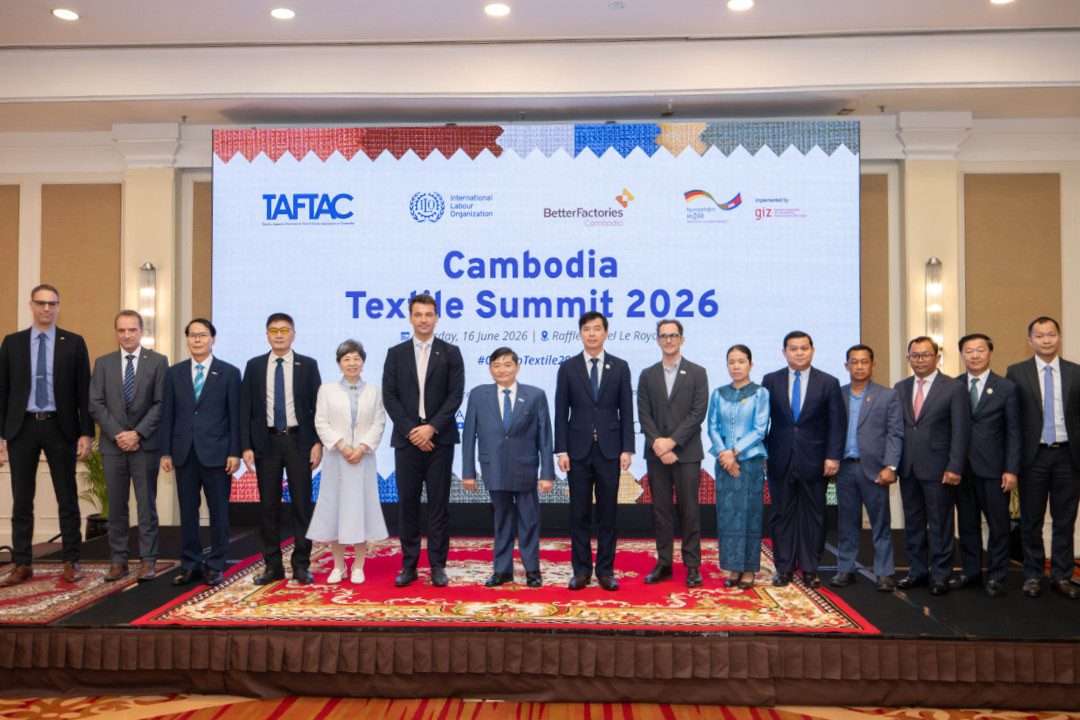
The Cambodia Textile Summit 2026 convened nearly 300 government officials, industry leaders, international organisations, trade unions, and development partners at Raffles Hotel Le Royal in Phnom Penh on June 16, 2026, to discuss the outlook for the country's Garment, Footwear, and Travel Goods (GFT) sector.
The summit was co-hosted by the Textile, Apparel, Footwear and Travel Goods Association of Cambodia (TAFTAC), the International Labour Organisation (ILO), Better Factories Cambodia, and Deutsche Gesellschaft für Internationale Zusammenarbeit (GIZ) GmbH, with the support of EuroCham Cambodia, and with Canada as an international partner.
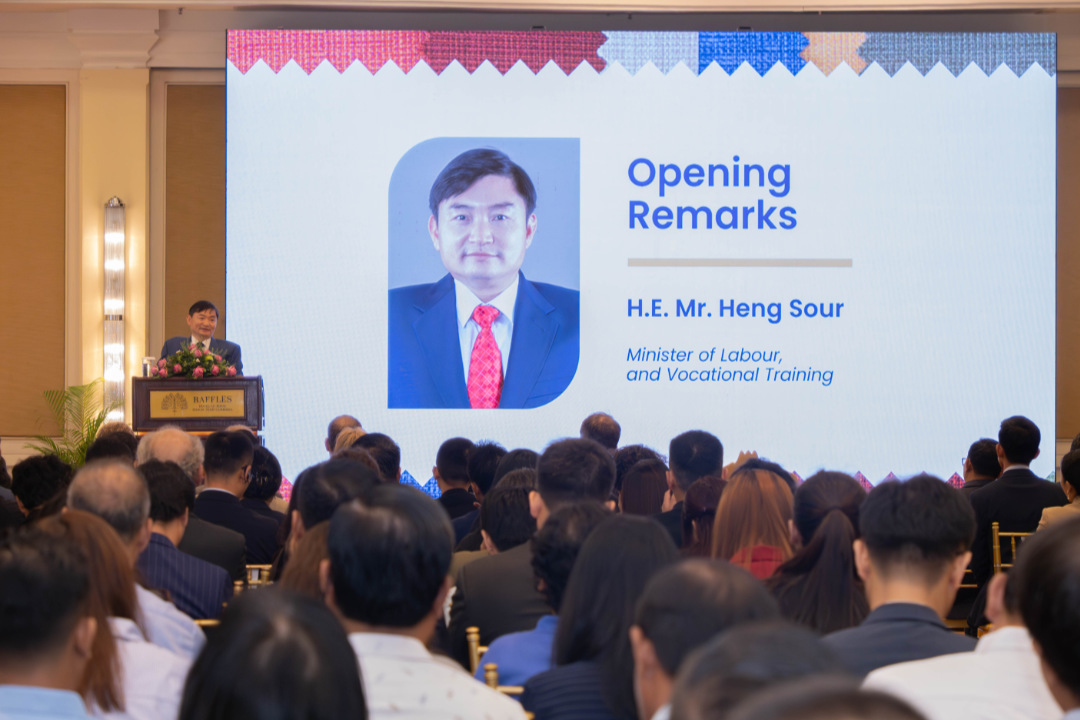
Welcome remarks were delivered by Robert Hwang, Deputy Chairperson of TAFTAC; Xiaoyan Qian, Director of the ILO Decent Work Technical Support Team for East and Southeast Asia and the Pacific, and Christof Weigelmeier, Deputy Head of Mission and Head of Cooperation at the German Embassy. H.E. Heng Sour, Minister of Labour and Vocational Training, delivered the opening address.
“We convene at a truly pivotal juncture, while the GFT industry is navigating an unpredictable blend of trade hurdles, fuel shocks, and worldwide economic instability, coupled with the reciprocal tariffs that are heavily eroding export margins, just as the global oil spike drastically inflates production and logistics costs," said H.E. Heng Sour. “With all these challenges, our objective is to examine critical policies, regulatory frameworks, and operational strategies that will reinforce Cambodia’s position as a favourable, competitive sourcing destination in the global apparel supply chain.”
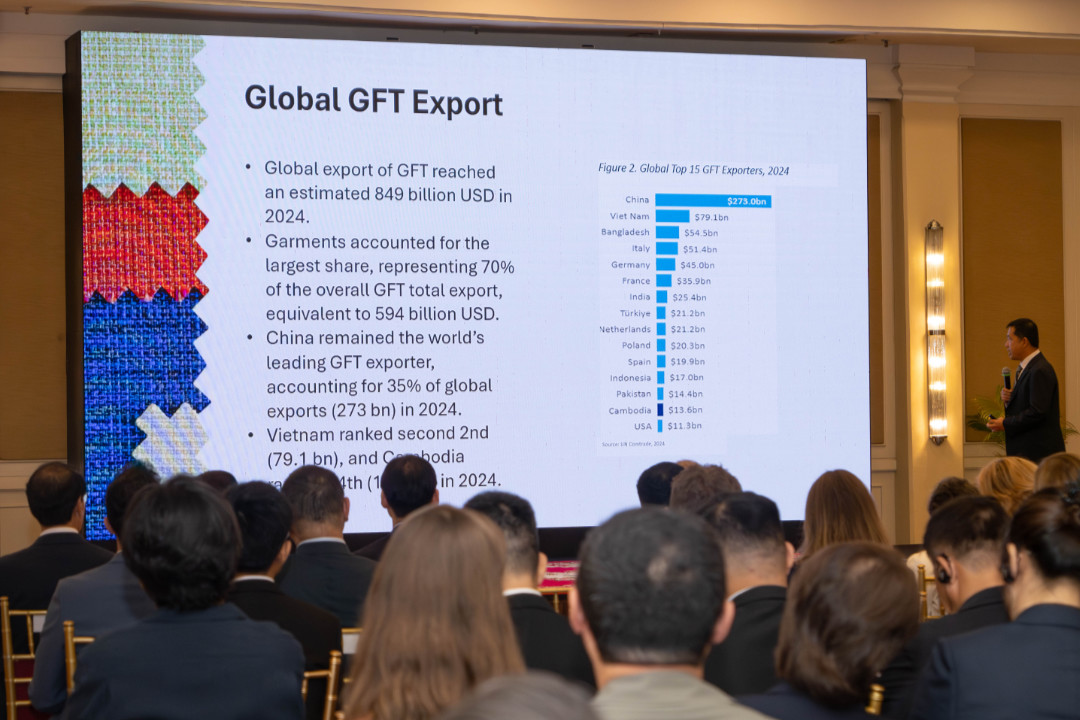
Dr. Ngov Penghuy, Managing Director and Senior Development Economist at International Economics Consulting, provided an overview of the GFT sector's role in Cambodia's economy and its position in global trends. He noted that the sector continues to provide the bulk of Cambodia's manufacturing employment and export earnings, even as the composition of exports gradually diversifies beyond garments into footwear and travel goods. He also addressed the structural pressures facing the industry, including Cambodia's scheduled graduation from Least Developed Country status, tightening rules of origin, and the need for greater investment in dyeing, finishing, and other upstream capabilities to remain competitive as preferential trade access erodes.
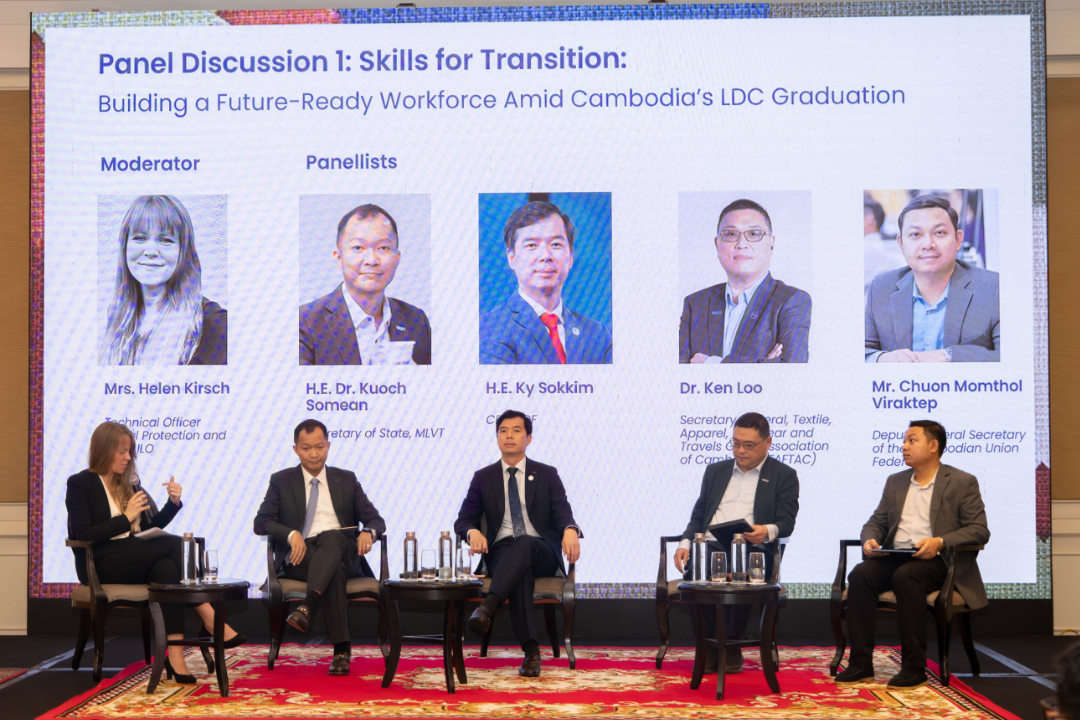
The first panel discussion was moderated by Helen Kirsch, Technical Officer of Social Protection and Jobs for the ILO, and featured Dr. Ken Loo of TAFTAC; H.E. Dr. Kouch Somen, Secretary of State of the Ministry of Labour and Vocational Training (MLVT); H.E. Ky Sokkim, CEO of the Skills Development Fund; and Chuon Momthol Viraktep, Deputy General Secretary of the Cambodian Union Federation. The panel focused on workforce readiness ahead of LDC graduation. Discussion centred on the newly developed Cambodia Skills Framework, an industry-led initiative intended to give factories a clearer structure for training and career progression, and on the respective roles TAFTAC and the Cambodian Garment Training Institute will play in its rollout.
“Cambodia's garment sector has always competed on cost, but that's no longer enough on its own,” said Dr. Ken Loo. “As we approach LDC graduation, the factories that will succeed are the ones that can offer something beyond price: reliability, quality, and a workforce that can move up the value chain alongside the products themselves.”
He added:
The Cambodia Skills Framework gives us, for the first time, a shared roadmap for what that progression actually looks like, from the factory floor to the management office. The next few years are about making sure every factory and every worker has a clear path to follow this framework.
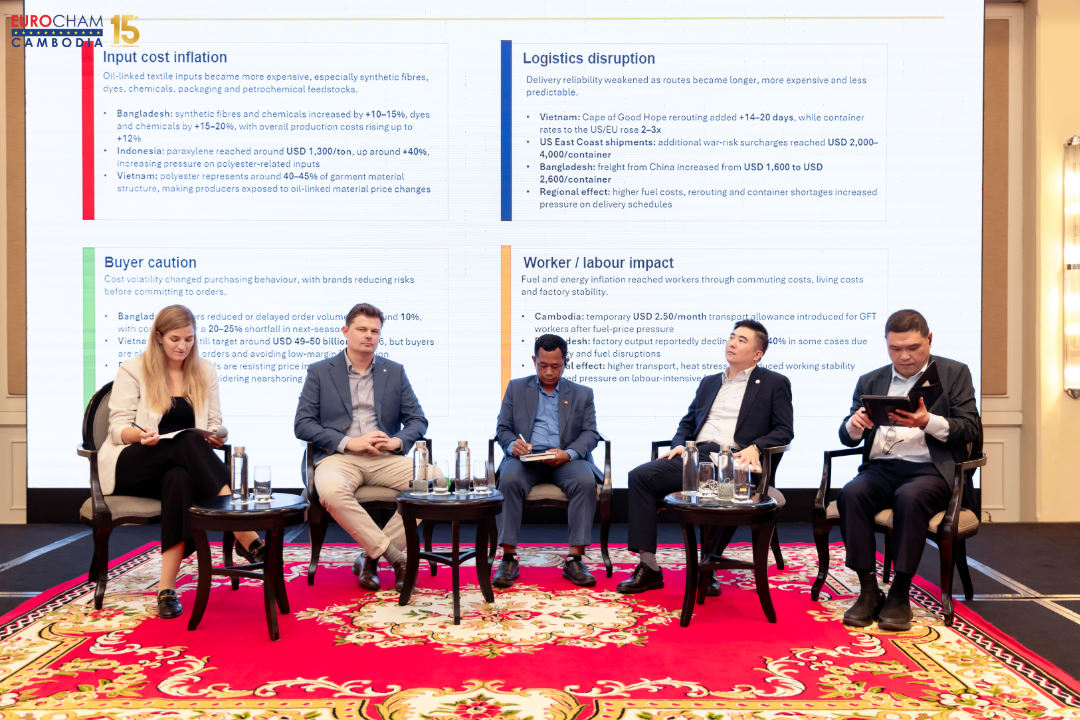
In the afternoon, Martin Brisson, Executive Director of EuroCham Cambodia, presented on the overlapping pressures currently facing the sector's supply chains, including the Cambodia-Thailand border situation, ongoing uncertainty around U.S. trade policy, and disruption linked to the conflict in the Middle East. He outlined how these pressures are amplifying each other and working their way through input costs, and shipping reliability, while pointing to steps already taken by factories, and buyers to adapt and emphasising the need for continued policy action.
“We can see now that these aren't isolated disruptions that the sector can absorb individually — the border situation, tariff uncertainty, and the fallout from the Middle East are all hitting at once, and they're compounding each other,” said Brisson. “But what's striking is that despite these shocks, Cambodia's GFT sector has kept growing: exports reached close to USD 16 billion in 2025, and we've seen continued diversification we've seen beyond garments into footwear and travel goods. It is also encouraging that we're already seeing the private sector respond.”
However, there remains need for a strong policy response: bringing down logistics and energy costs, accelerating rooftop solar and other affordable power options for factories, and building out the textile recycling capacity could help Cambodia come out of this period more resilient rather than just less exposed.
A subsequent panel, moderated by Maren Bremer, Lead Trade Advisor for the EU-German GATE programme, and including Rutger Heijsteeg of Maersk Cambodia; Kim Chansamnang, Vice President of the National Council for the Minimum Wage; Yuan Liu of Managing Director of TotalEnergies; and Dr. Ken Loo, built on this discussion to consider how the sector can strengthen its resilience going forward.
“Despite global economic shocks, exports of the GFT sector remain remarkably resilient, showing impressive year-on-year growth numbers. Even as supply chains are faced with longer lead-times and unexpected higher charges, resulting in reduced predictability regarding when goods will arrive and what importers will pay,” said Heijsteeg.
But there is opportunity for Cambodia to continue maturing its local logistics ecosystem, particularly by reducing administrative hurdles and reducing costs around customs and trade documents. This will further boost the confidence of buyers in Cambodia as a reliable, efficient sourcing market.
The programme then turned to circularity, with a presentation from Hasso Anwer, Project Director of GIZ FABRIC Cambodia, alongside Shamiul Hoque, Head of International Business Growth for Reverse Resources, and sustainability expert Massimiliano Tropeano. The session marked the launch of a new investor's guide to textile waste management and recycling in Cambodia, developed jointly by GIZ and TAFTAC, and highlighted the gap between the volume of textile waste the sector generates and the country's current capacity to recycle it domestically.
Speakers pointed to this gap as both a challenge and an emerging investment opportunity, supported by the growing track record of the Circular Fashion Partnership Cambodia in training factories and channelling waste toward formal recycling.
"We need to transform the way we think about circularity – instead of talking about waste management, let's call it material recovery and value creation, because this is the actual market opportunity," said Anwer.
"Textile scraps from the garment sector present an investment opportunity for sorting and recycling facilities, which would drive circularity in Cambodia and react to international markets' increasing demand for recycled content in garment products," added Tropeano.
A third panel, moderated by Froukje Boele, Country Programme Manager at ILO/IFC Better Factories Cambodia, and featuring Manh Narith, Director of the Ministry of Labour's Department of Occupational Safety and Health; Veronique Camerer, Head of Policy and Accountability at the International Accord; Dr. Vabotra Chea, GIZ Cambodia Environmental Policy Advisor; Yang Sophorn, President of the Cambodian Alliance of Trade Unions; and Leii Olicia, country Compliance Head for Fitly Apparel, addressed Cambodia's forthcoming Occupational Safety and Health law and the challenge of managing heat stress in factories.
“Heat stress has rapidly become one of the most pressing occupational safety and health challenges facing the industry globally, and the Summit highlighted the strong momentum building in Cambodia to address it,” said Boele. “Progress will depend on timely and effective regulation, continuous monitoring, low-cost tailored workplace solutions, and collaboration between factories and brands to protect workers from extreme heat.”
The day's final panel examined social dialogue as a mechanism for improving working conditions while preserving the sector's competitiveness. Moderated by Christina Rogers, Technical Officer of Social Dialogue of Better Work, the panel included H.E. Som Chamnan, Secretary of State at the MLVT; Anastacia Howe, Labour Rights Specialist of H&M Group; David Cichon, Head of Programmes for ACT; Christina Hajagos-Clausen, Director of Textile and Garment Industry of IndustriALL Global Union; Seang Yot, Legal Officer at CCAWDU; and Dr. Ken Loo of TAFTAC.
Closing remarks were delivered by Dr. Ken Loo, who reflected on the discussions held throughout the day and the work ahead for Cambodia's GFT sector as it approaches LDC graduation.
The summit concluded with a networking reception, bringing together participants from government, industry, and the international development community.
This press release was supplied.